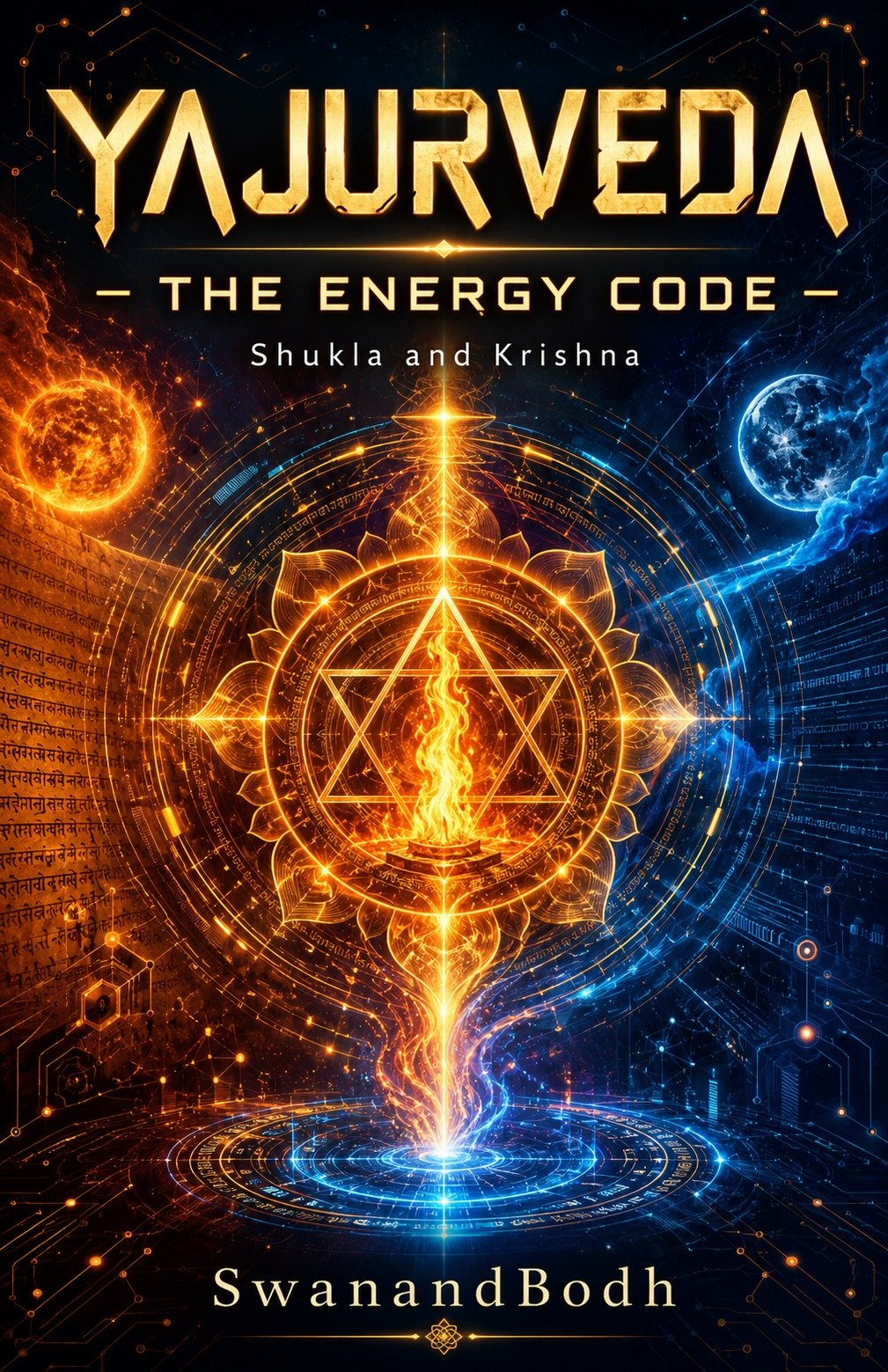
Yajurved The Energy Code: Exploring the Yajurveda Through a Modern Scientific Lens
Ancient Indian knowledge traditions contain profound ideas about action, process, transformation, nature and the relationship between the individual and the universe. Swanandbodh presents Yajurved The Energy Code as an intellectual exploration that attempts to examine these ideas through the language of modern systems engineering, energy management and thermodynamics.
The Yajurveda is traditionally associated with the procedures, mantras and operational aspects of Yajna. However, the book proposes looking beyond a purely ritualistic interpretation and examining the underlying process architecture of these practices. Through this perspective, Yajna is explored as a structured system involving inputs, processes and outputs.
The central idea is simple yet powerful: process plays a critical role in transformation. Whether discussing an ancient Yajna, biological processes or modern technology, the book encourages readers to think about how systems receive inputs, transform them and generate outputs.
Understanding Yajurveda as an Energy Code
The concept behind Yajurved The Energy Code is to reinterpret selected principles of the Yajurveda using terminology that is familiar to the modern scientific and technical mindset.
The Vedas are traditionally regarded as Apaurusheya, meaning knowledge that is not considered to be of ordinary human authorship. Within the traditional understanding, Vedic wisdom represents an eternal body of knowledge rather than merely an imaginative creation.
The book connects this traditional perspective with a modern inquiry into energy, processes and transformation. Rather than claiming that ancient terminology directly corresponds to modern scientific equations, the approach seeks to create a comparative framework through which readers can examine ancient concepts using contemporary analytical language.
This distinction is important because ancient philosophical and ritual concepts and modern scientific theories belong to different intellectual frameworks. The value of the comparison lies in encouraging questions, analysis and deeper investigation.
From Cosmic Knowledge to Applied Process
The traditional Vedic framework is often discussed as a vast body of knowledge concerning existence, nature, consciousness and cosmic order. In the book's conceptual framework, Yajurveda is presented as an applied energy model, focusing particularly on action and process.
This makes the idea of process central to understanding the book.
A system begins with certain inputs. Those inputs undergo a defined process and eventually produce outputs. This is commonly expressed in modern engineering as the Input-Process-Output (IPO) model.
The book uses this model to examine Yajna.
In this interpretation, physical materials offered during Yajna can be viewed as inputs, the controlled process involving fire and other factors represents transformation, and the resulting heat, light, sound, vapour and particulate emissions represent outputs.
This framework forms one of the key conceptual foundations of Yajurved The Energy Code.
Yajna Beyond a Ritualistic Interpretation
For centuries, Yajurvedic practices have often been approached primarily through their religious and ritual dimensions. The book proposes another perspective: studying the structure and operational logic behind these practices.
A Yajna, from this viewpoint, can be examined as a system rather than only as an act of offering.
This does not necessarily mean replacing the traditional spiritual interpretation. Instead, it creates an additional analytical lens.
The process can be considered in terms of:
-
Inputs and resources
-
Defined procedures
-
Transformation mechanisms
-
Outputs
-
Environmental interactions
-
Accuracy and repetition
-
Error correction
-
Synchronization
Such an approach can encourage readers to ask how ancient practitioners conceptualised sequence, precision, materials, timing and coordinated action.
Yajurveda and Thermodynamics
One of the most interesting themes explored in the book is Yajurveda and thermodynamics.
Thermodynamics studies energy, heat, work and transformations within physical systems. The book uses this modern framework as an interpretive tool for examining the transformation occurring during Yajna.
For example, combustion involves physical and chemical changes that produce heat, light and various gaseous and particulate products. Studying these transformations can provide a modern physical description of what happens during a fire-based process.
The book goes further by exploring whether concepts such as order, transformation and energy optimisation can provide useful analogies for understanding Yajurvedic processes.
These comparisons should be approached as an intellectual and interpretive exercise rather than as proof that ancient texts were literally written using modern thermodynamic theory.
Systems Engineering and Yajurvedic Architecture
Another major theme is Yajurveda systems engineering.
Systems engineering is concerned with designing, integrating and managing complex systems. It looks at how individual components interact to create a functioning whole.
The book applies this perspective to large Yajna structures such as Agnicayana and Somayaga, examining their organisation, sequence and operational requirements.
From this perspective, a complex Yajna can be studied in terms of architecture, components, procedures, dependencies and coordination.
This approach also highlights the importance of precision. A complex system requires its components to work together according to defined relationships. The book explores how this principle can be used as a framework for analysing ancient ritual architecture.
Shukla and Krishna Yajurveda
The Yajurveda developed through different traditions, most prominently the Shukla Yajurveda and Krishna Yajurveda.
The book discusses the Shukla Yajurveda and Krishna Yajurveda comparatively, presenting them through the metaphor of different forms of code.
The Shukla Yajurveda, particularly the Vajasaneyi Samhita, is presented as a more clearly structured or optimised framework in the book's analogy. The Krishna Yajurveda, represented by traditions such as the Taittiriya Samhita, combines procedural material with explanatory elements.
The book examines the 40 Adhyayas of the Vajasaneyi Samhita and the seven Kandas of the Taittiriya Samhita through a systems-oriented perspective.
Rather than attempting to reproduce every mantra and ritual, the emphasis is placed on understanding the larger architecture and organisation of the knowledge.
Energy Transformation in Yajna
The concept of Yajurveda energy transformation is central to the book's proposed framework.
A physical offering placed into fire undergoes a transformation. Its physical state and chemical composition can change, producing different forms of energy and matter.
From a modern physical perspective, combustion and heat transfer can be studied through established scientific principles. The book uses these observable processes to create a bridge between the practical structure of Yajna and contemporary discussions about transformation.
This approach also connects with the broader idea of Yajna energy transformation, where an input does not simply disappear but undergoes a process that changes its form and produces outputs.
The book encourages readers to look at this transformation as part of a larger systems model.
Fault Recovery and Data Integrity
A particularly distinctive aspect of the book is its comparison of certain Yajurvedic concepts with modern fault-management systems.
The book interprets Prayashchitta, or prescribed corrective practices, through the analogy of fail-safe algorithms. In modern engineering, fault recovery mechanisms are designed to identify errors and prevent them from causing larger system failures.
Similarly, the book examines Vachashuddhi, or purification of speech, through the analogy of maintaining data integrity and reducing communication noise.
These comparisons demonstrate how ancient concepts can be studied using modern terminology. They also invite readers to consider whether principles such as accuracy, correction, discipline and communication have relevance across different knowledge systems.
Sustainability and Synchronization
The book also explores sustainability and resource management through selected Yajurvedic ideas.
Modern sustainability focuses on responsible resource use, environmental balance, recycling, conservation and long-term system stability. The book identifies certain Yajurvedic references and practices that it interprets in relation to these themes.
Similarly, large-scale Yajna processes require coordination among participants, materials, timing and procedures. This creates an opportunity to examine the concept of synchronization.
In this sense, ancient Indian science and technology can be explored not simply by searching for modern inventions inside ancient texts, but by examining how ancient knowledge organised observation, process, resources and human activity.
Why This Perspective Matters to the Modern Generation
Today's younger generation is surrounded by technology, engineering, data and scientific reasoning. Connecting ancient knowledge with these familiar concepts can create new opportunities for intellectual engagement.
Yajurved The Energy Code aims to encourage readers to approach India's knowledge heritage with curiosity rather than accepting either extreme: blindly glorifying ancient knowledge or dismissing it without investigation.
A balanced approach requires references, critical thinking, observation and disciplined reasoning.
The objective is not to force ancient concepts into modern scientific categories. Instead, it is to ask meaningful questions about what ancient systems can teach us about process, organisation, transformation and human thought.
Conclusion
Yajurved The Energy Code offers a distinctive attempt to examine Yajurvedic knowledge through the conceptual frameworks of energy transformation, systems engineering, thermodynamics, fault recovery and sustainability.
Its central message is that process is the key to energy optimisation. By examining Yajna as a structured process involving inputs, transformation and outputs, the book creates a bridge between traditional Vedic thought and contemporary technical vocabulary.
For readers interested in Yajurveda scientific interpretation, ancient knowledge systems, energy concepts and the relationship between tradition and modern analytical thinking, this approach offers an opportunity to explore familiar subjects from a different perspective.
Swanandbodh presents this work as an invitation to study India's intellectual heritage with curiosity, references, critical thinking and scientific temperament. Its larger purpose is not merely to provide information, but to encourage a deeper conversation between ancient wisdom and modern knowledge.
The journey begins when we stop asking only what an ancient practice looked like and start asking how its process, structure and underlying ideas can be understood.